

Election season can bring public issues, strong opinions, and challenging conversations into young people’s everyday lives. It can also give families opportunities to practice democratic literacy—the skills young people use to understand civic life, evaluate information, consider different perspectives, communicate respectfully, and participate in their communities.5
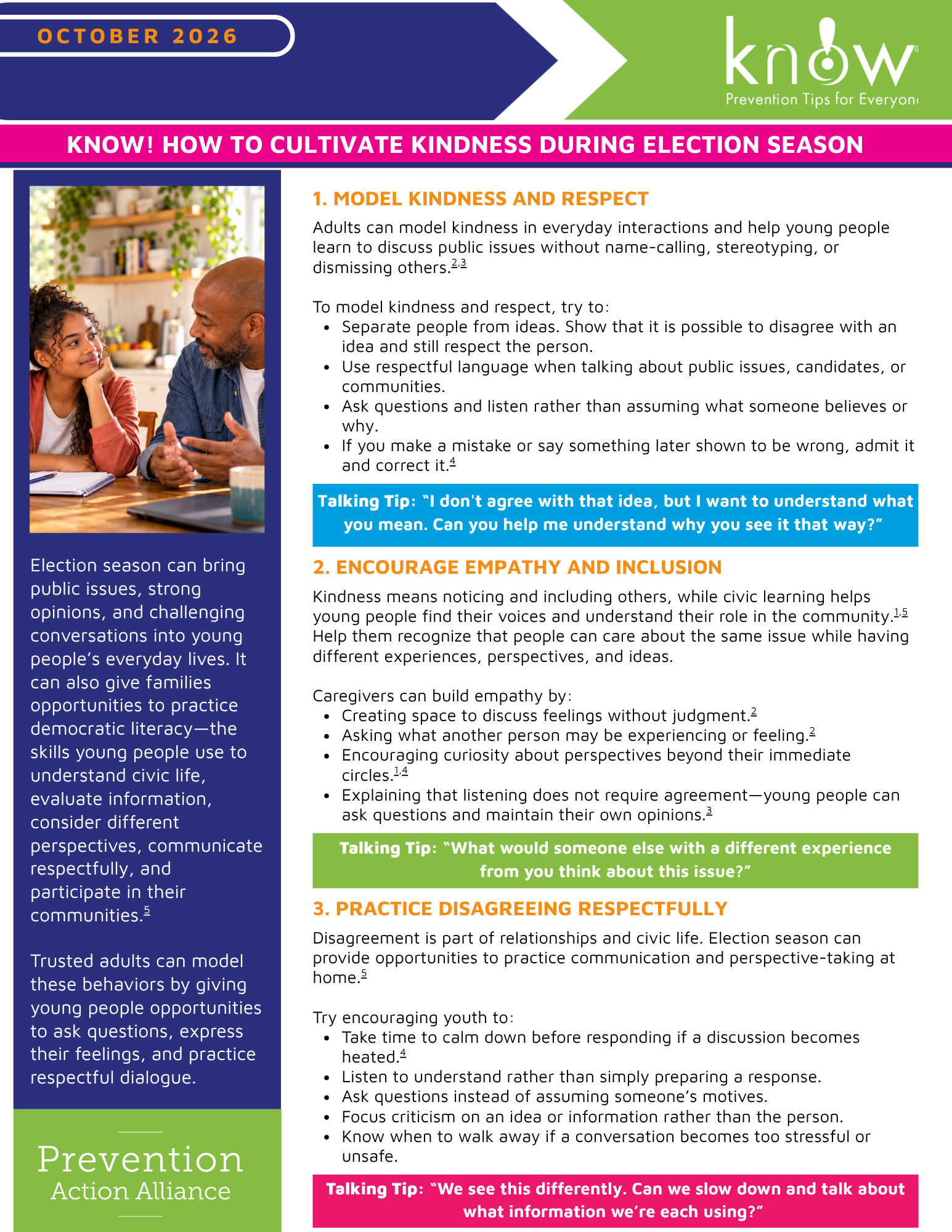
Trusted adults can model these behaviors by giving young people opportunities to ask questions, express their feelings, and practice respectful dialogue.
Download the PDF for the Full Tip
1.MODEL KINDNESS AND RESPECT
Adults can model kindness in everyday interactions and help young people learn to discuss public issues without name-calling, stereotyping, or dismissing others.2,3
To model kindness and respect, try to:
- Separate people from ideas. Show that it is possible to disagree with an idea and still respect the person.
- Use respectful language when talking about public issues, candidates, or communities.
- Ask questions and listen rather than assuming what someone believes or why.
- If you make a mistake or say something later shown to be wrong, admit it and correct it.4
Talking Tip:“I don't agree with that idea, but I want to understand what
you mean. Can you help me understand why you see it that way?”
2.ENCOURAGE EMPATHY AND INCLUSION
Kindness means noticing and including others, while civic learning helps young people find their voices and understand their role in the community. Help them recognize that people can care about the same issue while having different experiences, perspectives, and ideas.1,5
Caregivers can build empathy by:
- Creating space to discuss feelings without judgment.2
- Asking what another person may be experiencing or feeling.2
- Encouraging curiosity about perspectives beyond their immediate circles.1,4
- Explaining that listening does not require agreement—young people can ask questions and maintain their own opinions.3
Talking Tip: “What would someone else with a different experience from you think about this issue?”