

Suicide Prevention Special Edition: Part 2
In recognition of Suicide Prevention Awareness Month, we’re sharing a special two-part edition of Know! featuring guest author John Ackerman, PhD, Child Clinical Psychologist and Suicide Prevention Clinical Manager for the Center for Suicide Prevention and Research at Nationwide Children’s Hospital.
In Part 2, Dr. Ackerman shares practical guidance to help parents and caregivers prepare young people to recognize when a friend may be in crisis, respond with care, and connect them with a trusted adult—without feeling responsible for handling the situation alone.
Download the full Know! tip for additional guidance, and share it with the parents and caregivers in your community.
Download the PDF for the Full Tip
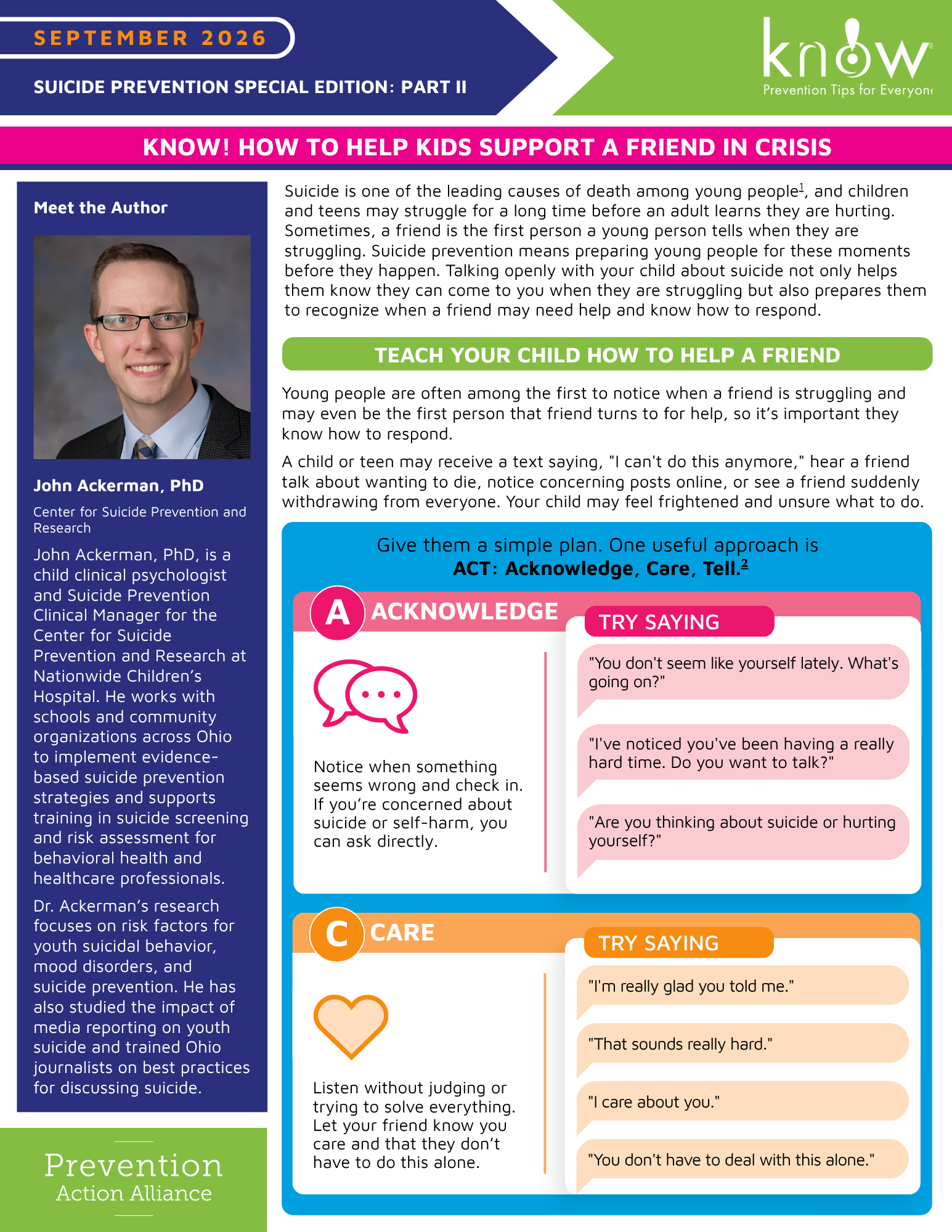
Suicide is one of the leading causes of death among young people1, and children and teens may struggle for a long time before an adult learns they are hurting. Sometimes, a friend is the first person a young person tells when they are struggling. Suicide prevention means preparing young people for these moments before they happen. Talking openly with your child about suicide not only helps them know they can come to you when they are struggling but also prepares them to recognize when a friend may need help and know how to respond.
Teach Your Child How to Help a Friend
Young people are often among the first to notice when a friend is struggling and may even be the first person that friend turns to for help, so it’s important they know how to respond.
A child or teen may receive a text saying, "I can't do this anymore," hear a friend talk about wanting to die, notice concerning posts online, or see a friend suddenly withdrawing from everyone. Your child may feel frightened and unsure what to do.
Give them a simple plan. One useful approach is ACT: Acknowledge, Care, Tell.2
ACKNOWLEDGE
Notice when something seems wrong and check in. If you’re concerned about suicide or self-harm, you can ask directly.
Try Saying:
- "You don't seem like yourself lately. What's going on?"
- "I've noticed you've been having a really hard time. Do you want to talk?"
- "Are you thinking about suicide or hurting yourself?"
CARE
Listen without judging or trying to solve everything. Let your friend know you care and that they don’t have to do this alone.
Try Saying:
- "I'm really glad you told me."
- "That sounds really hard."
- "I care about you."
- "You don't have to deal with this alone."
TELL
Tell a trusted adult. This is the most important part.
If a friend talks about suicide, self-harm, or seems to be in danger, children and teens should tell a parent, counselor, teacher, coach, or another trusted adult. Teach your child that suicidal thoughts are not a secret to keep. When possible, encourage your child to go with their friend to get help rather than simply telling an adult and walking away.
If a Friend Says:
“Promise you won't tell anyone."
Try Saying:
"I care about you too much to keep this to myself. Let's find an adult who can help us."
Start the Conversation
Talking openly about suicide is an important first step. In Part 1 of this special edition, Dr. Ackerman shares practical guidance to help parents and caregivers talk with young people about suicide, recognize warning signs, ask directly when they are concerned, and connect them with help.